by Martina Barbour, Literacy Director
This year, we welcomed 9 young people into our Summer Youth Internship program. The theme that guided our learning was Reduce, Reuse, Recycle. Through this lens, we worked with the interns on the ideas of sustainability, caring for the environment, and how plants can be used in a variety of ways. We also aimed to show them how we can reduce our carbon footprint by reusing items and “trash” by bringing them new life and purpose.
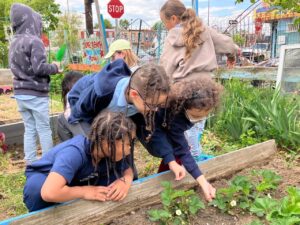
Throughout their work with Tito and the garden staff, they learned about crop rotation, mulching, ecosystems beneath the trees, soil health, pollinators, and weeding. We also incorporated lots of special activities and trips into the program.

Taylor of Rise and Ritual led a 3 week herbalist series teaching our interns how to identify and harvest various herbs, as well as understanding the properties and benefits of each. These sessions were highly interactive as they learned how to make hair oil from herbs and beeswax and candle making with essential oils and dried flowers.

Michael, an FAO Schwarz Fellow with The Food Trust, led a multi-week series focused on nutrition. The interns started by learning about “always foods” and “sometimes foods”, parts of plants, and harvesting, which culminated in making a delicious kale, chickpea and lemon salad. On another day, they were able to harvest summer squash to make a squash, cucumber, onion and white bean salad. Like all new things this summer, we encouraged interns to at least try a taste and many really enjoyed it!

We also had the Philadelphia Orchard Project join us for an ice cream making workshop! Corrie talked about some of the plants we could harvest to add to the icecream and then the interns chose what they wanted – mulberries, peaches, and blueberries. It’s always a fun workshop and the icecream was delicious! On another day, Carolyn, our History Educator, led an anti-violence workshop with three activities to help promote cooperation and participation. After each activity, she took time to process with the interns what was learned. Our friends from CHOP also stopped by one day for a career workshop. We heard from an audiologist, a speech therapist, and someone in marketing. Each specialist talked about what they do, what populations they serve, how they got into their field, and what schooling they completed. They answered intern questions and provided lots of handouts and resources.

We love exposing our interns to the great opportunities and wonderful people in their neighborhood by taking them on field trips. At Life Do Grow Farm, they learned about their programming and helped with some gardening alongside Urban Creator’s own interns. At Taller Puertorriqueño, they got to view the staff artwork currently on exhibit and meet with the creators. Special thanks to our board member Marilyn, Taller’s Education Director, for sharing her own story and making this such an impactful experience. In sticking with our sustainability theme, we also visited Historic Germantown where the exhibit Cardboard Genius showed interns the beauty that can be created from found materials. Finally, we were grateful to be able to take them to Lillian Marrero Free Library to conduct plant research when the temperatures were in the high 90s.

We try to tie literacy into all that we do and that includes our youth internship program. This year, we incorporated a series of picture books focused on our theme in order to prompt discussion and inspiration. Some of these books included A Small Hole in a Tree, The Girl Who Heard the Music, A Seed is Sleepy, and Ada’s Violin. After reading 10 Things I Can Do to Help My World together, they were able to share what they are doing themselves to help their planet and their community. On our field trips, we were also able to introduce them to two fabulous bookstores – Uncle Bobbie’s and Julia de Burgos – and let them each pick out a book to purchase.

On the final day of the program, we celebrated the intern’s accomplishments together. We gave them letters of appreciation, highlighting their unique accomplishments and contributions to the program. The interns shared some of their highlights throughout the summer, which included meeting and making new friends, learning about Fair Hill’s history and space, and learning about plants and their many uses. We would be honored to have them back to participate in our future events and programs.
Our hope is that all of this collaborative and rich programming will help to spark interest and curiosity for these incredible interns. We hope our theme of Reduce, Reuse, Recycle facilitates a sense of responsibility and agency for the world around them: their neighborhoods as well as the larger global community and natural world. We honor Historic Fair Hill’s legacy by uplifting reciprocity, equity, sustainability, and stewardship.