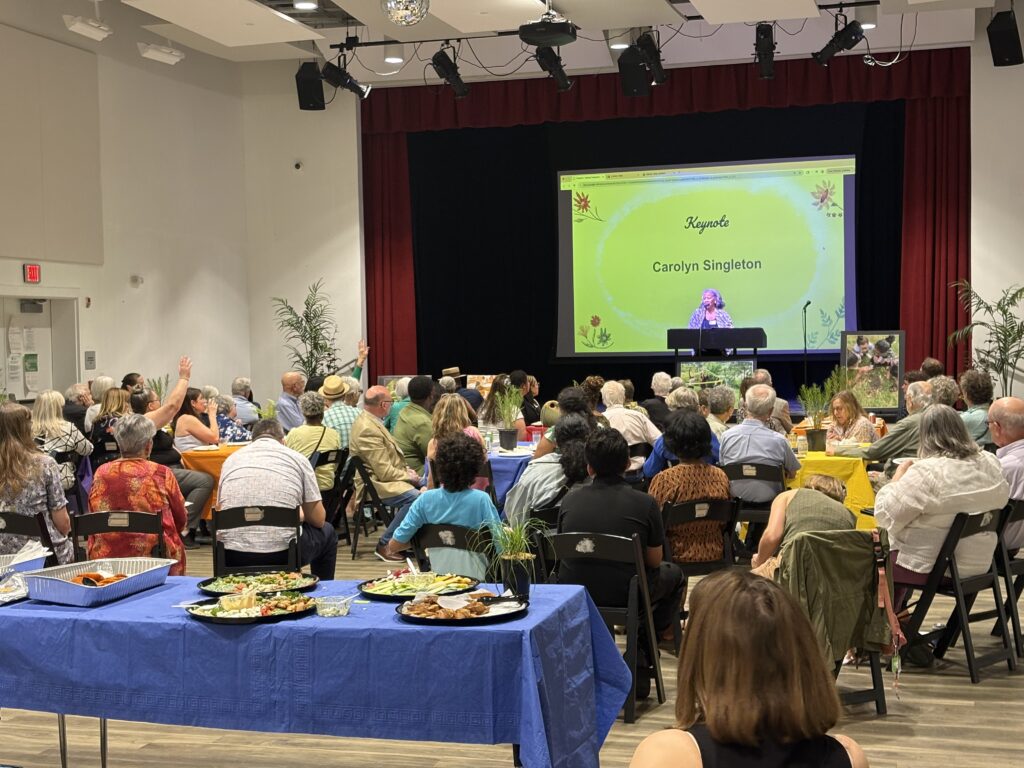
by Carolyn Singleton, History Educator (adapted from 2026 Spring Celebration Keynote)
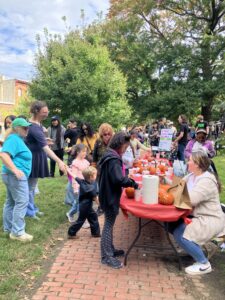
In 2013, I was working with a group of gentlemen, who had recently been released from prison and were working to help others. An after school program and then a summer camp grew organically. I volunteered by helping to create some structure and to bring in healthy snacks. There was a Quaker gentleman who would often drop in and he used to always mention bringing the kids down to the “burial ground”. I would acknowledge him and smile, thinking to myself, “Why in heaven would I bring kids to a cemetery to play.”
Well now we needed a location for a summer camp and I was in a pinch. So the Friday afternoon prior to the start of camp, I quietly went down and walked the perimeter. I didn’t tell anyone, I just quietly walked around, and I felt magic. I could re-imagine this space as a place where children could come and have fun. And they did.
Historic Fair Hill is an organization that brings together three powerful forces, forces that originated with the 1754 Last Will and Testament of George Fox, the founder of the Religious Society of Friends. He wanted the space to be used for, “a meeting place, a schoolhouse, a burying place, a playground for the children in town to play on, a garden to plant with physical plants for lads and lasses to know simples, and learn to make oils and ointment”. We can’t separate that from the guiding principles of Quakerism – simplicity, peace, integrity, community, equality, and stewardship. The reason why I continue to associate with HFH is because it embodies these guiding principles along with honoring the wishes of HFH’s benefactor.
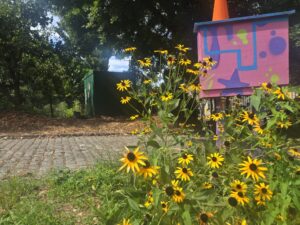
I do history tours focusing on the contributions and legacy of Lucretia and James Mott, Robert and Harriet Purvis, and the individuals painted on the Harriet Tubman Mural right across the street from the burial ground. In addition to the Underground Railroad mural, there are 4 other murals which are often included. Each tour is different, depending upon the age group of the participants. During the tours we have the opportunity to share stories, talk about current events, and speak about our own identities and heritage.
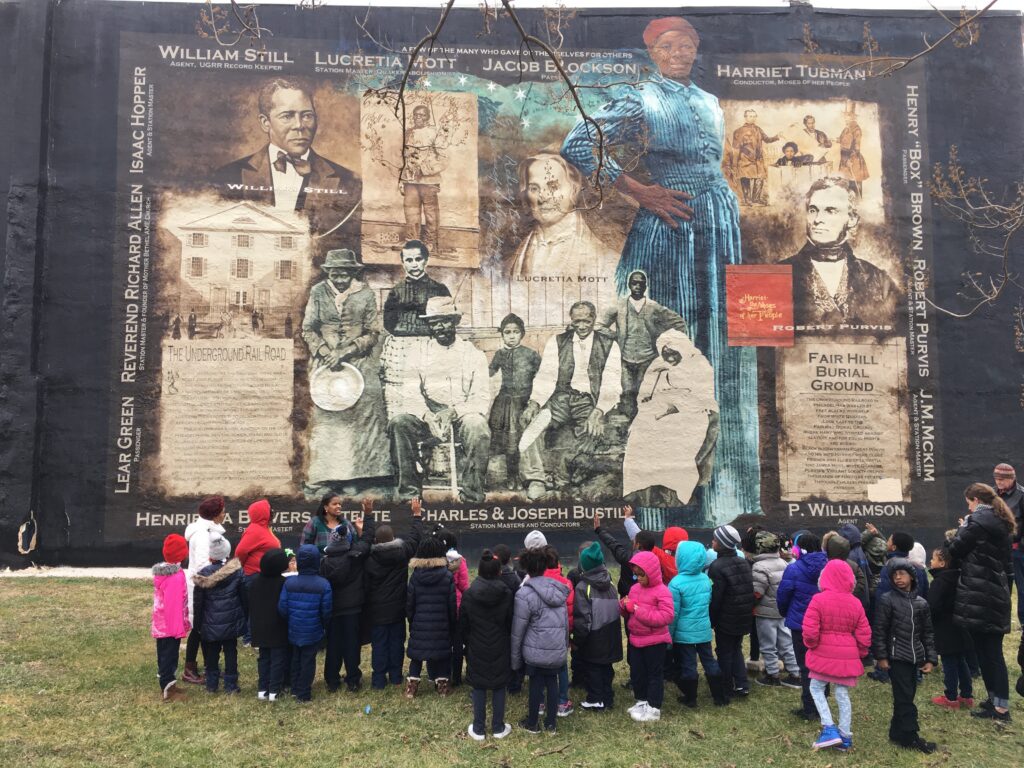
Historic Fair Hill serves as a bridge across time, spanning a period of over 300 years. In March, I took a vacation to Natchez, Mississippi. I had been there many times before, visiting family, visiting friends. On this trip, I visited the Natchez Black Museum and a local black cemetery established in 1909 by the Natchez Colored Cemetery Association. I thought about the Abolitionist movement in Philadelphia and the work of the Purvis’ and Motts and the Pennsylvania Anti-Slavery Society and the Philadelphia Female Anti-Slavery Society. I thought about Philadelphia being a stop on the Underground Railroad and their homes being used to hide run-away slaves. I find it a privilege to be able to share their stories during my tours in Fairhill at a time when so much history is being erased.
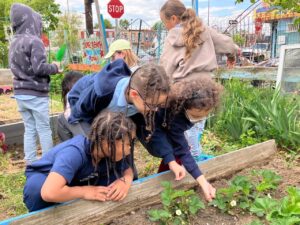
Let’s talk about the environment and HFH as a “garden to plant with physical plants” and a green space. When I first came to HFH, I was helping with the field trips for the neighboring elementary schools. It was at that time that I had to “learn” my trees. I was the teacher as well as the student. Jean Warrington, the executive director at the time, picked a leaf from each tree, wrapped it, and labeled it with the name of the tree. That was 12 years ago. Fast forward, the HFH gardens and the garden activities stimulate my interest and curiosity leading to my having a vegetable garden, planting two fruit trees and most recently becoming the mother to four baby chicks. Tito talks to me about about the ecosystem and composting. And I’m still learning.
And then there is education, the thread that ties it all together. We all know that there is a connection between a lack of education and poverty, employability, economic stress, crime, and over-policing of neighborhoods. When I do anti-violence workshops in different settings, whether it be in schools, the community or the prison setting, I see first-hand how a lack of exposure to positive activities leads to acts that people later regret. You compound that with the social injustices and you have the pipeline to prison. HFH embodies peace, a place for people of all ages to come and feel safe.
Visitors to HFH come in all ages and from many places. Last Friday, we had a 7th grade class trip from Alaska. The students were thrilled to share what life is like living amongst moose, caribou, and bears. We did a history and mural tour, they asked questions, then we did a tour of the gardens, they asked questions, and then the real fun started – they got their gloves and started digging in the soil, remember – “to plant physical plants for lads and lasses to know simples, and learn to make oils and ointment”. While they were doing their planting exercise, one of the teachers and I walked to the corner so she could buy hoagies for everyone. On the way back we could see the kids playing on the tire that hangs from the tree, running around, and lying in the grass. Her words, “they really needed this, this is great.” They were playing, they were learning, and they were having fun. The day exemplified what HFH is all about.
I am grateful to Historic Fair Hill for being a place where I have been allowed to play, learn, share, facilitate, and contribute to future generations. My hope for future generations and those associated with HFH is that they continue to keep the wishes of George Fox alive and that they continue to nurture what has been started here and embrace Quaker guiding principles of simplicity, peace, integrity, community, equality, and stewardship.